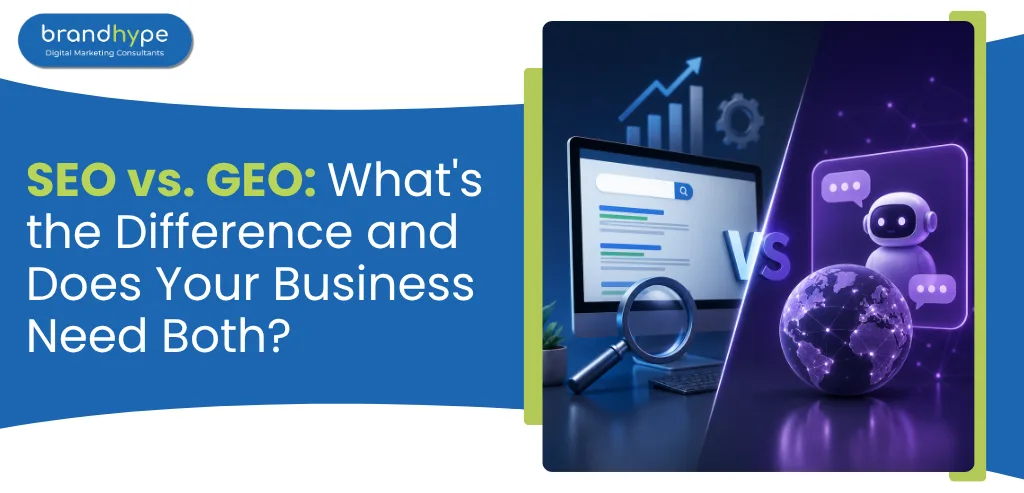
SEO(Search Engine Optimisation) earns visibility in ranked search results. GEO (Generative Engine Optimisation) earns visibility inside AI-generated answers. Both draw on the same website but reward different things. SEO rewards pages that rank. GEO rewards passages that can be quoted by AI models (like ChatGPT, Perplexity, or Gemini). Most businesses now need both, because one query can produce a link list and an AI answer at the same moment.
What is SEO?
SEO, or search engine optimisation, is the practice of improving a website so that it appears higher in traditional ranked results on search engines like Google, Yahoo, Bing, etc. Success is a position, and the reward is a click.
SEO rests on three pillars:
- Technical: crawling, indexing, speed and site structure
- Content: intent match, keyword coverage and depth
- Authority: backlinks, brand mentions and reviews
What is GEO?
GEO, or generative engine optimisation, is the practice of preparing content so that AI systems such as Google AI Overviews, ChatGPT, Perplexity and Gemini select it, summarise it and cite it.
GEO does not chase a position. It chases inclusion. The engine reads many sources, extracts the clearest passages and writes a single answer. Your task is to be one of the sources that survives that filter.
What is the difference between SEO and GEO?
The difference is the unit of success. SEO optimises a page for a rank. GEO optimises a passage for a citation.
| Factor | SEO | GEO |
|---|---|---|
| Goal | Rank in the link results | Be cited inside the AI answer |
| Unit Optimised | The whole page | The individual passage |
| User Behaviour | Clicks a link | Reads the summary |
| Query Style | Short keywords | Long conversational questions |
| Main Lever | Backlinks and authority | Clarity, structure and factual density |
| Content Shape | Comprehensive article | Self-contained answer blocks |
| Measured By | Rankings and clicks | Citations and mentions |
| Typical Timeline | Months | Weeks once structure is corrected |
Does your business need both SEO and GEO?
Yes, in almost every case. The two are not alternatives. They answer different moments in one journey.
AI answers are assembled from indexed pages. Without SEO, there is nothing for a generative engine to read. SEO alone leaves you invisible when the user reads the AI answer and never scrolls.
Generative engines lean heavily on sources that already rank well, so ranking still decides who is considered.
Quick Test
If a customer would speak the question aloud to an assistant, you need GEO. If they would still compare options on a results page, you need SEO. Most journeys contain both.
How do SEO and GEO work together in practice?
Consider a small accountancy firm.
Query one: ‘best chartered accountant near me’. This returns a map pack and ranked links. SEO wins the click.
Query two: ‘do I need a chartered accountant to file GST returns for a small business.’ This returns an AI summary. GEO wins the citation.
The same firm needs both. The first query captures existing demand. The second creates demand by making the firm the trusted explanation. A reader who meets your name inside an answer often searches your brand next, which feeds SEO.
Which signals do generative engines reward?
Generative engines favour content that is easy to lift and hard to dispute.
- Answer-first paragraphs of forty to sixty words placed directly under a question heading.
- Headings written as real questions rather than keyword fragments.
- Facts, figures, dates and named sources inside the passage itself.
- Structured data such as Article and FAQPage schema.
- Visible author credentials and clear organisation details.
- Consistent facts across your website, listings and third-party mentions.
- One idea per paragraph and short declarative sentences.
- Tables and lists that can be extracted whole.
How can you check whether your content is AI SEO ready?
Score any page out of eight. Award one point for each yes.
| No. | Check | Yes or No (Your Checklist) |
|---|---|---|
| 1 | Does a question heading sit above every section? | |
| 2 | Is the direct answer given within the first sixty words? | |
| 3 | Does the page contain a comparison table or a list? | |
| 4 | Are Article and FAQPage schema present? | |
| 5 | Is a named author with credentials shown? | |
| 6 | Are claims supported by figures, dates or sources? | |
| 7 | Can any single section stand alone if extracted? | |
| 8 | Is the page indexed and crawlable? |
Interpretation:
- Zero to three: A traditional SEO page. It may rank, but it is unlikely to be quoted.
- Four to six: Partly extractable. Restructuring will usually lift citations.
- Seven to eight: Citation ready. Now focus on authority and freshness.
How does a digital marketing agency support both?
Brandhype, a digital marketing company with a presence in Delhi, Noida and Gurgaon, treats GEO as a layer built on SEO, not a replacement for it.
- Repair the technical base: indexation, site structure and schema.
- Rewrite content into question-led, answer-first blocks.
- Publish machine-readable files such as llms.txt alongside robots.txt.
- Track citations across AI platforms, not rankings alone.
Catering to diverse businesses across all industries in India, USA and Canada, our team has systematically rebuilt core corporate pages and informational blog clusters into answer-first formats. By adding precise schema frameworks and optimizing factual density, we have consistently tracked immediate gains in AI Overview citations and engine mentions alongside traditional organic ranking reports.
If you want to discuss your queries further, reach out to our team at +91 987-3405308 and let’s find a workable solution for your brand escalation.
Frequently asked questions
Is GEO replacing SEO?
No. Generative engines draw from indexed web pages, so SEO remains the supply line. GEO changes how content is presented, not whether it needs to exist.
Can a small business compete at GEO?
Yes. GEO rewards clarity more than budget. A well-structured page of eight hundred words can outperform a large site that buries its information.
How is GEO measured?
By citations and mentions inside AI answers, by branded search volume, and by referral traffic from AI platforms. Rank tracking alone will not capture it.
Which should come first- SEO or AI SEO?
SEO. Without indexation and baseline trust, there is nothing for a generative engine to quote.
How long does GEO take?
Structural changes are often reflected within weeks, because engines re-read pages frequently. Authority gains built via external verification take longer.