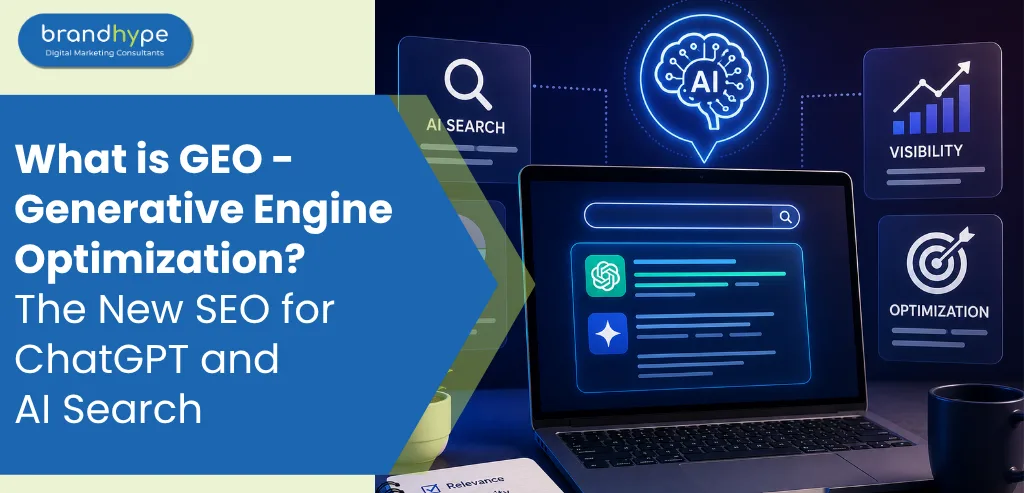
Ask ChatGPT to recommend a supplier in your category. If a competitor comes back and you do not, that is the problem GEO exists to solve. Generative Engine Optimization is the work of getting your brand named inside AI-generated answers.
What is GEO in marketing?
GEO is the practice of structuring your content, your technical setup and your off-site presence so that AI systems such as ChatGPT, Perplexity, Gemini, Claude and Google AI Overviews retrieve and cite you when they answer a question.
The term came from a 2024 KDD paper by teams from Princeton, Georgia Tech, the Allen Institute for AI and IIT Delhi. The researchers found that the right content changes lifted a page’s visibility inside AI answers by roughly 30 to 40 percent. By 2026 the discipline sits on most serious content roadmaps.
You will also see AEO and LLMO used for the same work. The goal is identical: be the source the model uses.
How is GEO different from SEO in 2026?
SEO competes for a position. GEO competes for a mention.
That difference changes what success looks like. A link at position three earns a click. A citation inside an AI answer may earn no click at all, yet the user still leaves with your brand name and your version of the argument.
It also breaks an old assumption. Ranking well on Google no longer guarantees an AI engine will quote you. Studies through 2025 and 2026 keep finding limited overlap between the pages Google ranks first and the pages generative engines cite.
How do ChatGPT and Perplexity decide which sources to cite?
Most engines follow the same sequence, which Google documents.
First comes query fan-out. The engine does not search your exact question. It splits it into smaller ones and searches each separately. A question about the best CRM for a small agency fans out into pricing, integrations and reviews.
Then retrieval, where the engine pulls passages it can read and extract cleanly. Then synthesis into a single answer. Finally attribution, where a handful of sources get named.
So you are not optimising for one keyword. You are trying to be the cleanest answer to a cluster of sub-questions.
How do you optimise your brand for ChatGPT and Perplexity?
Let the AI crawlers reach your pages
Check robots.txt and your CDN rules for blocks on GPTBot, OAI-SearchBot, PerplexityBot and ClaudeBot. Many sites block these without knowing, because security defaults changed and nobody checked. Read your server logs to confirm the bots arrive. For Google, a page must be indexed and snippet-eligible before it can surface in AI features at all.
Answer the question before you explain it
Put the direct answer in the first 40 to 60 words, under a heading written as the question a buyer would ask. Retrieval systems judge a page largely on its opening. Context and nuance come afterwards. If a reader has to scroll past three paragraphs of scene-setting, so does the model, and it will take a cleaner page instead.
Give the model something worth quoting
The Princeton research found the biggest gains came from statistics, quotations and cited sources. That points somewhere specific: original numbers from your own data, named experts with real credentials, dated findings, comparison tables with real values. Recycled summaries do not get cited because there is nothing in them to prefer over the next identical page.
Earn presence on the pages models already read
Owned content is only part of it. Review platforms, industry directories, Wikipedia and Wikidata, Reddit and Quora threads and trade publications all feed AI answers. Note the limit. Google has said plainly that chasing inauthentic mentions does not work. Real coverage from credible third parties does.
Keep your entity data identical everywhere
Company name, address, phone number, founder names and description should match across your website, Google Business Profile, LinkedIn and every directory listing. Contradictory data makes a model hedge or skip you. Consistent data makes it confident enough to name you outright. Organization, Article, Product and FAQ schema support this, though Google notes markup is not required for its own AI features.
How do you measure GEO performance?
Start with Search Console. Its Generative AI performance report is the only first-party data on how your content performs inside Google’s AI features.
Add referral tracking in GA4 for chatgpt.com, perplexity.ai, gemini.google.com and copilot.microsoft.com. Volumes look small next to organic search, so judge them on conversion quality. AI referrals arrive further down the buying journey.
Then build the dataset nobody can sell you. Pick 25 to 50 prompts your customers genuinely type, run them weekly across the major engines, and log whether you appear and who does instead. Ten weeks of that gives you a share of voice trends and shows which formats earn citations in your category.
Treat any tool claiming access to internal AI ranking signals with suspicion. None has it.
Does GEO replace SEO?
No, and Google has said so directly. Its 2026 guidance states that optimising for generative AI search is still SEO, because AI Overviews and AI Mode run on the same core ranking and quality systems as ordinary search. It also lists what you can ignore for Google: llms.txt files, chopping content into tiny chunks and special AI-only markup.
The brands winning citations in 2026 are almost always the ones with clean technical foundations, genuine expertise and a real off-site footprint. GEO layers on top of that work.
Where should you start with GEO?
Run twenty prompts your buyers would use and record which brands the engines name. Fix crawler access. Rewrite your ten most commercially important pages so each answers its question in the opening lines. Publish one piece of original data a competitor cannot copy.
Re-run the same twenty prompts in eight weeks. That before-and-after file will teach you more about GEO than any subscription.