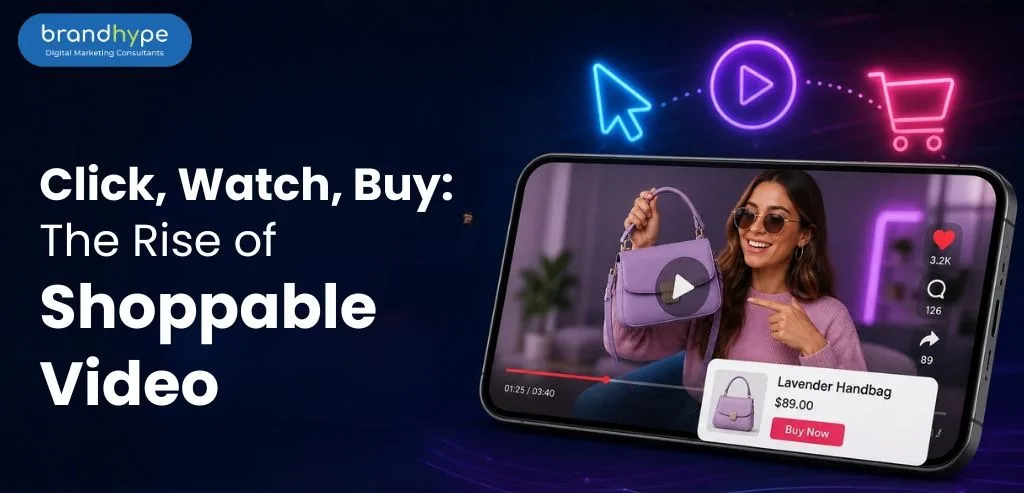
A user discovers your product. Watch it in action. Buy it instantly. All within the same screen. No website hopping. No comparison loops. No delay. This is what a shoppable video has changed.
Content is no longer just influencing decisions, it’s completing them.
A Shift That Didn’t Announce Itself
There wasn’t a single moment when this change happened.
It crept in quietly.
First, platforms pushed video.
Then, they added product tags.
Then checkout options.
Now, the line between content and commerce has almost disappeared.
Today’s buyer doesn’t follow a funnel. They follow momentum.
Why This Format Works So Well
Think about how people consume content now.
They don’t sit and analyze.
They react.
Shoppable video works because it aligns perfectly with that behavior:
- It reduces thinking time
- It removes friction
- It speeds up decision-making
And the numbers support it:
- Video-driven product discovery leads to significantly higher engagement
- Users are far more likely to buy after seeing a product in action
- Short-form video continues to outperform static formats across platforms
This isn’t about better content. It’s about faster decisions.
What’s Actually Happening in That 30–60 Seconds
A lot more than it seems.
A high-performing shoppable video typically:
- Captures attention within seconds
- Builds context without overexplaining
- Shows the product in use
- Creates urgency or relevance
- Enables immediate action
All of this happens almost subconsciously for the viewer.
That’s the power of combining visual proof + instant access.
The Mistake Most Brands Are Making
They’re still thinking in silos.
- Content team creates videos.
- Marketing team tracks engagement.
- Sales team looks at conversions.
But shoppable video doesn’t work in parts.
It works as a single system.
When that connection is missing:
- Videos get views but no sales
- Products get exposure but no traction
- Effort increases, results don’t
The Role of Context (More Than Creativity)
Many brands assume creativity is the main driver.
It’s not.
Context matters more.
A visually stunning video that lacks clarity will underperform.
A simple video with clear intent can outperform everything else.
The difference comes down to:
- How quickly the product is understood
- How relevant it feels to the viewer
- How easy it is to take action
What High-Performing Brands Are Doing Quietly
Instead of chasing trends, they’re building repeatable systems.
You’ll notice patterns like:
- Consistent content formats
- Clear storytelling structures
- Strong product positioning
- Tight integration with shopping features
They’re not experimenting randomly.
They’re refining continuously.
Where the Real Opportunity Lies
Shoppable video is still evolving.
Which means:
- Organic reach is still accessible
- Competition is still uneven
- Consumer behavior is still forming
This creates a window where early movers can:
- Build stronger recall
- Capture faster conversions
- Establish category dominance
But this advantage won’t last indefinitely.
A Practical Way to Think About It
Instead of asking: “How do we make better videos?”
Ask: “How do we make it easier for someone to buy after watching?”
That shift alone changes:
- How you script content
- How you present products
- How you measure success
Why This Matters More in Fast-Moving Markets
In cities like Delhi, user behavior is:
- Rapid
- Mobile-first
- Content-driven
Which means:
- Decisions are quicker
- Attention is shorter
- Expectations are higher
This makes shoppable video not just effective, but necessary.
A well-structured approach from a digital marketing company can help connect content performance with actual business outcomes, instead of just surface-level metrics.
The Overlooked Layer: Search + Video
Another shift happening in parallel:
Video is no longer limited to social feeds.
It’s influencing:
- Search results
- Product discovery journeys
- Brand recall cycles
This is where a forward-thinking seo company in Delhi integrates video into broader visibility strategies, rather than treating it as a separate channel.
Rethinking What “Good Content” Means
Earlier, good content meant:
- High engagement
- Strong visuals
- Trend alignment
Now, good content means:
- Clarity
- Relevance
- Actionability
Because the end goal has changed.
It’s no longer about being watched. It’s about being acted upon.
Where Brandhype Fits Into This Shift
We at Brandhype don’t focus on producing content, we focus on aligning content with outcomes.
The approach is centered around:
- Designing video flows that naturally lead to action
- Structuring content around user behavior, not assumptions
- Connecting visibility with conversion, not just engagement
- Continuously improving performance based on real data
The idea is simple: Make content work harder, so your audience doesn’t have to.
What This Changes for You
If you’re creating content today, the expectation has shifted.
It’s no longer enough for your audience to:
- Like your content
- Share your content
- Remember your content
They should be able to act on it instantly.
That’s the new benchmark.
The Real Question Moving Forward
It’s not: “Are you creating video content?”
It’s: “Can someone buy from you the moment they’re convinced?”
In today’s environment, the gap between interest and action is shrinking.
And the brands that remove that gap fastest… Are the ones that grow fastest.